
Slope on a golf rangefinder measures the angle between you and the target and turns the straight-line distance into a “plays like” number: longer when the flag is above you, shorter when it is below. The laser still measures the real distance; a built-in inclinometer reads the angle, and the unit shows an adjusted yardage next to it. Bushnell’s own manual gives the textbook example: a flag 162 yards away at +4 degrees plays as 173.
It is a practice and casual-round tool. Under Rule 4.3a(1), measuring elevation changes is not allowed during a round, which is why every mainstream slope rangefinder now has a switch to turn it off. Below: the geometry, the maths with worked numbers, what the adjusted figure leaves out, how to read the display, the rules, and whether slope is worth paying for.
Slope in five lines
- Laser measures line-of-sight distance; an inclinometer measures the angle; the unit combines the two
- Uphill adds yards, downhill subtracts them. Bushnell’s example: 162 yards at +4° plays as 173
- That example matches a simple rule almost exactly: horizontal distance plus the height change (161.6 + 11.3 = 172.9)
- In yards that means roughly one yard for every three feet of rise or drop
- Not allowed in competition (Rule 4.3a(1)); a physical switch with a visible indicator is how you show it is off
What slope actually measures
A laser rangefinder times an infrared pulse to the target and back, which gives the straight-line distance: the diagonal from your eye to the flag. How that part works is on how golf rangefinders work. A slope model adds a small tilt sensor (an inclinometer) that reads the angle of that line above or below horizontal at the moment you fire. From distance and angle, the unit can work out two things you cannot see: how far away the flag is horizontally, and how far it sits above or below you.
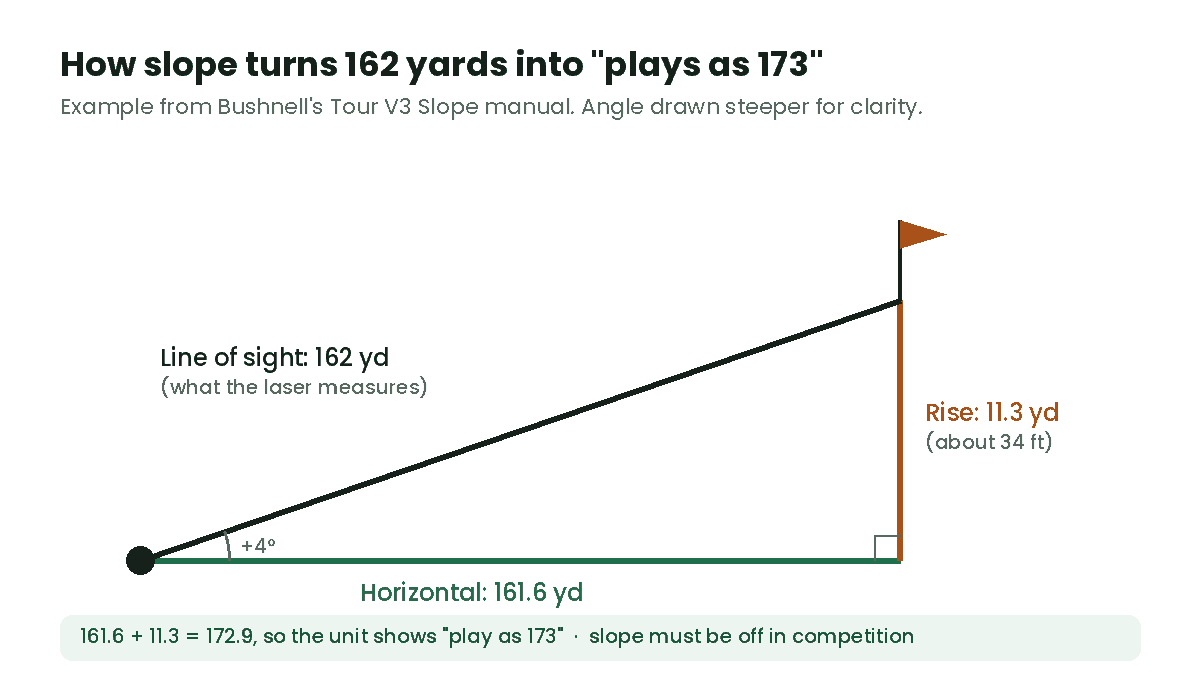
Notice how little the horizontal distance changes: 162 yards of line of sight at +4° is 161.6 yards across the ground. On any angle you meet on a golf course, the diagonal and the horizontal are almost the same. The number that moves your yardage is the rise, 11.3 yards or about 34 feet in this example, and that is what slope adds on.
The maths, using Bushnell’s own example
Bushnell’s Tour V3 Slope manual shows a reading of 162 yards, +4 degrees and a “play as” distance of 173 yards. Two lines of trigonometry reproduce it:
- Horizontal distance = distance × cos(angle) = 162 × cos 4° = 161.6 yards
- Rise = distance × sin(angle) = 162 × sin 4° = 11.3 yards (about 34 feet)
- Plays like ≈ horizontal + rise = 161.6 + 11.3 = 172.9, which the unit rounds to 173
That is the whole idea: a ball that has to climb 34 feet needs roughly the carry it would need to go 11 yards further on the flat. Downhill it runs the other way. Put in golfer’s terms, every three feet of height change is worth about a yard, added uphill and taken off downhill.
Plays-like distances at a glance
The simple model applied to common approach distances. Height changes are shown in feet so you can compare them with what you see on the course.
| Line-of-sight distance | +3° (uphill) | +6° | +9° |
|---|---|---|---|
| 100 yards | 105 yd (rise 16 ft) | 110 yd (31 ft) | 114 yd (47 ft) |
| 150 yards | 158 yd (24 ft) | 165 yd (47 ft) | 172 yd (70 ft) |
| 200 yards | 210 yd (31 ft) | 220 yd (63 ft) | 229 yd (94 ft) |
| Line-of-sight distance | −3° (downhill) | −6° | −9° |
|---|---|---|---|
| 100 yards | 95 yd (drop 16 ft) | 89 yd (31 ft) | 83 yd (47 ft) |
| 150 yards | 142 yd (24 ft) | 133 yd (47 ft) | 125 yd (70 ft) |
| 200 yards | 189 yd (31 ft) | 178 yd (63 ft) | 166 yd (94 ft) |
Two things stand out. Small angles already matter: 3 degrees at 150 yards is 8 yards, a full club for most golfers. And the effect grows with distance, so the same angle costs more on a long approach than on a pitch. That is the honest case for slope: most golfers cannot judge 3 degrees by eye, but they can feel a one-club error.
How to read slope on a rangefinder display
Every brand lays the screen out differently, but the pattern is the same. When slope is on you will see more than one number:
- The line-of-sight distance: what the laser measured. This is the number you are allowed to use in competition.
- The adjusted, plays-like distance: usually larger on screen on newer units, or labelled with a “play as” style symbol. On the Tour V3 Slope it sits under the true distance, next to the angle.
- The angle in degrees on some models: plus for uphill, minus for downhill.
The simple test: if you see two distances, slope is on. Units with a physical switch also show a coloured mark on the body when slope is active (orange or red on Bushnell Shift models, green on the Precision Pro R1). Where the switch is on each model is on how to turn off slope on a rangefinder.
What the slope number leaves out
A slope reading answers one question, how much the height change is worth, and it answers it well. It does not know about anything else, which is why good players treat it as a starting point:
- Wind. A laser cannot see it, and into-the-wind uphill shots can play a lot longer than the slope number.
- Temperature and altitude. Cold, dense air shortens the ball and thin air at altitude lengthens it. Standard slope ignores both; the Pro XE’s Elements mode is Bushnell’s answer.
- Your ball flight. The same height change affects a high wedge and a low-flying long iron differently. One adjusted number cannot know which club you are holding.
- Lie, stance and turf. An uphill lie, a downslope or a firm, fast green all change the shot in ways the flag angle does not capture.
- Where you aimed. Slope is calculated to whatever the laser hit. A reading off the trees behind the green gives you the wrong angle as well as the wrong distance.
The practical use is learning. Play a few rounds with slope on, note how far uphill and downhill shots really play for you, and you build a feel that you keep when the switch goes off. Locking the flag first is its own skill; the technique is on how to use a golf rangefinder.
Is slope legal in golf?
Distance, yes; slope, no. Rule 4.3a(1) of the Rules of Golf allows “getting information on distance or direction (such as from a distance-measuring device or compass)” and does not allow “measuring elevation changes”. The penalty is the general penalty, two strokes in stroke play or loss of the hole in match play, and a second breach is disqualification. The rule applies in any round played under the Rules, not only in events, as the USGA told GOLF.com.
What changed the market was the 2016 revision that let golfers use a slope-capable device as long as the slope function is disabled. Bushnell’s Tour V4 Slope Edition was designed around that, with slope that could be turned on and off. Older units such as the Tour V3 Slope Edition have no off setting at all, so they stay practice-only. Today the norm is a physical switch with a visible indicator, which lets a playing partner or referee see at a glance that the unit is measuring distance only. A committee can still ban distance-measuring devices altogether with a Local Rule, so check the event notice. Which events and tours allow what is on are rangefinders legal in golf.
Rangefinder slope is not the course Slope Rating
The word causes endless confusion in search results. A course’s Slope Rating, printed on the scorecard next to the Course Rating, has nothing to do with hills. It is a handicap-system number that expresses how much harder a course plays for a bogey golfer than for a scratch golfer; the standard value is 113 and ratings run from 55 to 155. A rangefinder’s slope function is simply the angle to the target. A flat course can have a high Slope Rating, and a hilly one a low one.
Is slope worth paying for?
Less of a question than it used to be: most mid-range and premium lasers now include slope and a switch, so the real choice is usually between a unit with a proper switch and one without. Where it still matters:
| Your situation | Slope worth it? | Why |
|---|---|---|
| Hilly or mountain course | Yes | Height changes of 20–60 feet are worth one to two clubs, which is hard to judge by eye |
| Flat parkland course | Rarely | A few feet of change is a yard or two; the line-of-sight number is enough |
| Mostly competition golf | Only with a visible switch | You will have it off most of the time; buy for the switch, not the feature |
| Learning a new course or improving distance control | Yes | Practice rounds with slope on teach you how elevation plays |
| Tight budget | Optional | A distance-only unit ranges the flag just as accurately |
How each brand turns slope off
| Model | How slope switches off | Visible indicator? |
|---|---|---|
| Bushnell Tour Shift models (V4 Shift to V7 Shift) | Side Slope-Switch | Yes, coloured mark |
| Bushnell Pro X3 / X3+ | Locking Slope-Switch: unlock, then slide | Yes |
| Bushnell Pro XE | Side Slope-Switch; Elements toggles with Mode | Yes, red indicator |
| Bushnell A1 Slope | Mode button | No |
| Bushnell Tour V3 Slope Edition | Cannot be switched off | — |
| Precision Pro NX9, NX10, Titan | Physical slope switch | Yes |
| Blue Tees Series 3 Max / 4 Ultra | Side Slope Switch | Yes |
| Callaway 300 Pro | Side slope switch | Yes |
| Garmin Approach Z82 | Settings menu | No |
If you are choosing a model on this basis, rangefinders with slope, sorted by how the switch works compares them, and the Bushnell line is laid out switch by switch on which Bushnell rangefinder to buy.
What does slope do on a rangefinder?
It measures the angle to the target and adjusts the laser distance for the height change, showing a plays-like number that is longer uphill and shorter downhill. Bushnell’s example: 162 yards at +4 degrees plays as 173 yards.
Do you add or subtract yards when hitting uphill?
Add them uphill and subtract them downhill. A simple guide that matches Bushnell’s example is about one yard for every three feet of height change, so a green 30 feet above you plays roughly 10 yards longer.
Is a rangefinder with slope legal in tournaments?
The device is allowed if the slope function is switched off; measuring elevation changes during a round breaches Rule 4.3a(1). The penalty is two strokes in stroke play or loss of the hole in match play, and a second breach is disqualification.
How accurate is slope on a rangefinder?
The angle and distance are measured accurately, but the plays-like number only accounts for height. Wind, temperature, altitude, lie and the height of your ball flight are not included, except on models like the Bushnell Pro XE, which adds temperature and pressure.
Is slope worth it on a golf rangefinder?
On hilly courses and for learning how elevation plays, yes. On flat courses and for golfers who mostly play competitions, it adds little; if you buy it, choose a model with a physical switch and a visible indicator.
What is the difference between slope on a rangefinder and a course Slope Rating?
They are unrelated. Rangefinder slope is the angle to the target. A course Slope Rating is a handicap number that shows how much harder a course plays for a bogey golfer than a scratch golfer, with 113 as the standard.
What does a second number on my rangefinder mean?
It means slope is on. The unit is showing both the line-of-sight distance and the adjusted plays-like distance. Turn slope off with the switch or menu for competition rounds.
How this page was made. Written by The Golf Rangefinder editorial team from manufacturer specifications, published manuals and aggregated owner reviews. We do not test rangefinders in hand and we never claim to. Last checked: September 2026. Prices change; the retailer page is the final word.
Sources
- Bushnell Golf — Tour V3 / Tour V3 Slope user manual (162 yd, +4°, play as 173 example)
- Bushnell Golf — Pro XE user manual (Slope with Elements)
- USGA — Rules of Golf, Rule 4 (4.3a(1) distance and directional information)
- The Golf Wire — USGA ruling and the Tour V4 Slope Edition (2016)
- GOLF.com — rangefinder rules and slope usage
- Precision Pro Golf — NX9 Slope product page (slope switch)
- Plays-like tables calculated by us with the horizontal-plus-rise model; switch data from the manufacturer sources on our model index